.jpg)


The Role of Mindfulness in Coping with Test Anxiety: How to Calm Our Brains?
- Nazlı Aras
- Dec 23, 2025
- 3 min read

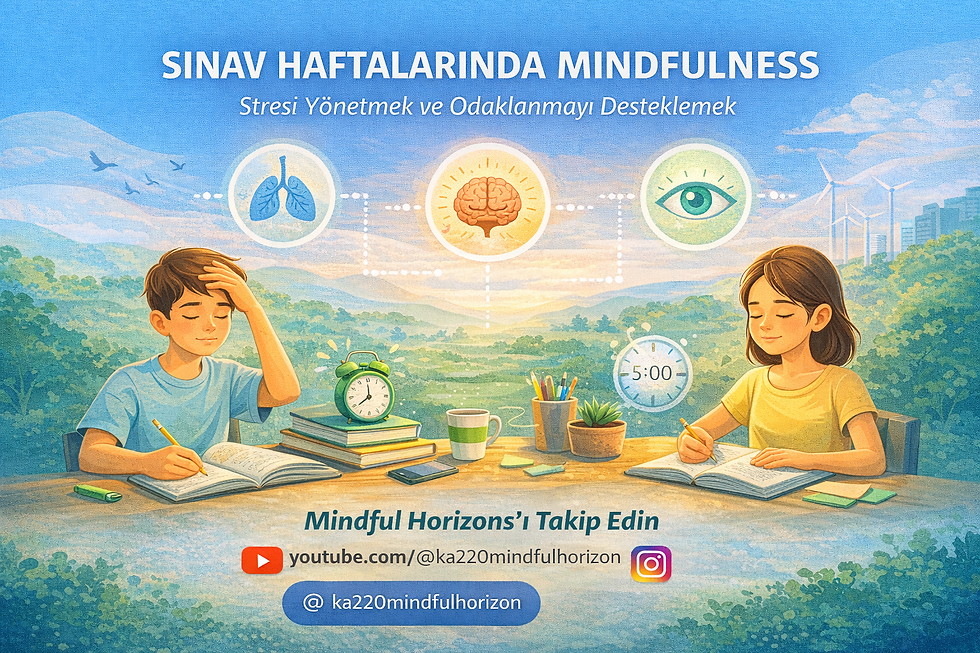
Pen in hand, exam paper in front of you. You actually know the topics; you studied for days. But right at that moment, your heart starts racing, your palms get sweaty, and you feel like everything you know has been erased from your mind.
Sound familiar? We call this "test anxiety," and it is much more than just getting "a little nervous." So, what exactly happens in our brains during this moment of intense anxiety, and how can Mindfulness help us?
What Happens in Our Brains? (A Quick Science Break)
When we experience test anxiety, the Amygdala, our brain's "alarm center," kicks in. It sends a message to the body: "Danger! Fight or Flight!"
The problem is, there is no physical danger (like a wild animal); there is just a piece of paper. However, when the Amygdala takes over, the Prefrontal Cortex—the center responsible for logical thinking, problem-solving, and memory—temporarily locks up. That moment when you say, "I forgot everything I knew," is actually the moment your brain switches to alarm mode and shuts down its logic center.
How Does Mindfulness Step In?
Mindfulness isn't about completely eliminating anxiety; it is about managing it. Mindfulness practices turn off the alarm by sending the message to your brain: "You are safe right now, this is just an exam, there is no life-threatening danger." This allows the logical brain (Prefrontal Cortex) to come back online.
Here are 3 effective Mindfulness strategies you can use before or during an exam:
1. The "4-7-8" Breathing Technique (The Emergency Brake)
During anxiety, our breathing becomes rapid and shallow. You can use this technique while the exam papers are being distributed or when you get stuck on a difficult question.
4 Seconds: Inhale deeply and calmly through your nose.
7 Seconds: Gently hold your breath.
8 Seconds: Exhale slowly through your mouth, as if blowing out a candle.
Repeating this 3-4 times physically slows down your heart rate.
2. Seeing Thoughts as "Clouds"
Our minds love to write disaster scenarios before exams: "I'm definitely going to fail," "I won't be able to do anything." Mindfulness teaches us not to get swept away by these thoughts. When they arise, say to yourself: "I notice that I am having the thought that I will fail. This is just a thought, not a fact." Imagine these thoughts like clouds in the sky; they come and go. You don't have to hold onto them.
3. Returning to "Now" with Your Senses
Anxiety takes us to the future (to the exam result). Mindfulness brings us back to "now." If you panic during the exam, put down your pencil and focus on these for 30 seconds:
Feel the hardness of the desk under your hand.
Notice how firmly your feet are planting on the floor.
Listen to the rustling of paper or a sound from outside. Focusing on your body anchors the mind in reality, not in the chaos of the moment.
Conclusion: It Can Be Developed Like a Muscle
Coping with test anxiety is a skill that can be learned, just like riding a bike. Practicing Mindfulness for 5-10 minutes a day—not just on exam morning, but throughout the preparation period—increases the brain's tolerance for stress.
Remember; an exam paper can measure your knowledge, but never your worth!
This article was prepared within the scope of the Mindful Horizons Erasmus+ project to support the academic and emotional resilience of students.